
This Is Our “17 Seconds” Newsletter #143: 17 Seconds = Useful Info Quickly.
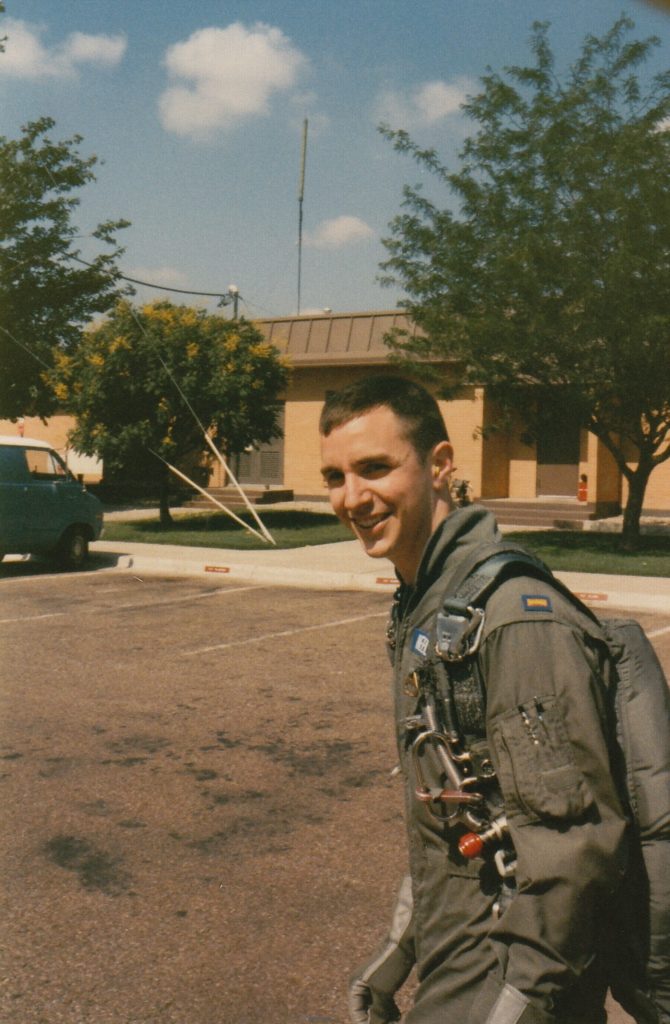
With the Artemis II mission now complete (https://en.wikipedia.org/wiki/Artemis_II), it’s been an exciting month for NASA! Which got me thinking about my brush with NASA greatness.
With apologies, this may take longer than 17 seconds to read. Hopefully it will be worth it.
Cape Elizabeth High School, Maine
I was a good math/science student in high school, long before the silly “STEM” term became popular. When I was preparing to apply to college, high school guidance counselors told me, and I paraphrase (hereinafter), “Hey, you’re smart; you should be an engineer!”
To which I replied, “That’s cool, I like trains!”
Nobody bothered to tell me what an engineer is or does. Had my guidance counselors told me that an engineer is someone who designs things, then I might have considered what sorts of things I liked – or might like to design.
Growing up a poor kid in a rich town, I knew that I would need a scholarship to be able to afford college, so I applied for Army, Navy, and Air Force Reserve Officer Training Corps (ROTC) scholarships. I was awarded all three scholarships and had to make a (seemingly) informed decision about which to accept. The Navy told me that they did not care about my major, presumably because they planned to put me on a boat. My Uncle John was in the Navy, but that was not enough for me to go Navy. The Army told me that I had to major in something technical, which I planned to do. Also, my brother, father, and grandfather were all in the Army, so plus one for the Army. Finally, the Air Force told me that I had to major in electrical engineering (whatever that is), and I decided to choose the Air Force, figuring that I had the highest chance of actually doing what I had studied after I graduated and started active duty.
So my college choices were limited to those with Air Force ROTC (AFROTC) programs. My Mom said, “Your friend Tom is applying to MIT, so you should apply to MIT.” So I applied to MIT, and also to Harvard, BU, and UNH, and I was accepted to all except for Harvard. My grandfather graduated from Harvard Medical School in 1932, so I expected to be admitted to Harvard (as a legacy) but not to MIT. The opposite happened, so I went to MIT.
Massachusetts Institute of Technology (MIT), Cambridge Massachusetts
As it turns out, electrical engineering is one of the most difficult majors at MIT (perhaps only physics is more difficult). And as it also turns out, I didn’t particularly like EE and was not particularly good at it (these two things are related). I would have chosen civil engineering, mechanical engineering, or computer science (among others) over EE, but I did not have a choice of major.
When I asked the Air Force if I could change majors, they said that I could if I received a pilot scholarship. Just like the Navy doesn’t care what you major in (because they are going to put you on a boat), the Air Force doesn’t care what a future pilot majors in (because they are going to put you in a plane).
So I figured that if I was going to be in the Air Force, then I might as well try to be a pilot, which is not the reason most people choose this career path. And, as a bonus, I would get to change majors! I applied for a “pilot scholarship” (as it was called) and received that late sophomore year. Unfortunately, by that time, it was too late for me to change majors! Even to computer science, which would have been more of a lateral move than the other majors. So I found myself on a path to pilot training while still majoring in EE. Oops.
United States Air Force Pilot Training(s)
After my sophomore year, I completed AFROTC Field Training (a four-week program) at Plattsburgh AFB in upstate New York. Immediately following Field Training, I completed Initial Pilot Training (IPT) at Embry-Riddle Aeronautical University in Daytona Beach, Florida. At IPT, I went from never having flown an airplane to soloing in three weeks.
I graduated from MIT in the spring of 1988, and in the spring of 1989, I started USAF Undergraduate Pilot Training (UPT), class 89-08, at Reese Air Force Base in Lubbock, Texas. I had not flown in nearly three years, and while the academic portion of pilot training was not a problem for me, learning to fly jets quickly proved more difficult. Most of my classmates already had a Private Pilots License (PPL), a couple were already navigators in the USAF. To say that I was at a disadvantage would be an understatement.
I completed the ground, aerobatic (barrel rolls, aileron rolls, split-S, pulling 6 Gs, and the like), and solo portions, but that’s where pilot training ended for me. I got to solo a jet (Cessna T-37) twice, which was cool. They say that any landing you can walk away from is a good one. I can tell you with certainty that the Air Force has a higher standard than that. My landings were good but not good enough. About 40% of my class washed out of pilot training. The Air Force had plenty of pilots to choose from.
Astronaut Training
When the Air Force was trying to figure out what to do with me next, they sat me down and said, “Hey, you’re smart, and you know something about flying. We’d like you to be an astronaut!”
And I said, “No.”
“No, don’t give me the astronaut gig as a consolation prize for sucking at flying. Give that to the kid who has wanted to be an astronaut since they were four years old.”
Indeed. Give that gig to someone like my friend Mike, who was a year behind me at MIT. This is what Mike and I said the first time we met:
“Hi, my name’s Mike! I speak Russian!”
“OK, Mike,” I replied, “Odd intro, spin that out for me.”
“OK,” said Mike enthusiastically, “I’m going to be an astronaut, and some of the takeoffs and landings are going to occur in Russia, so I speak Russian!”
Give that kid the astronaut gig, not me, don’t waste it on me. Because then I might be taking Mike’s slot!
The Air Force will give you a second chance (as they did with the astronaut offer), but they will not give you a third. When I turned down the astronaut gig, I knew that my USAF career was over. I was 23 years old. But it was the first time in my life that I took charge of my own career: MIT, EE, pilot training, astronaut training – those were all other people’s ideas! It was time to figure out what Erik wanted to do.
I finished my USAF career at Hanscom Air Force Base in Massachusetts, and during that time I witnessed significant fraud, waste, and abuse. I decided to go to law school because I was going to single-handedly end fraud, waste, and abuse in the Department of Defense (DoD) acquisition system. And then the Internet happened, so I did that instead. But, entering law school, my intentions were pure. And later in life, I got a second bite at the apple by mentoring for the USAF Techstars startup program (see link below).
Now back to my friend, Mike, for a moment. I have told the story about Mike, and about saying “no” to astronaut training, many times. But I had never told it to Mike. So on 2025-11-24, I sent a message to Mike and told him that I had a story that I’d like to tell him. Two days later, he called me, and we spoke for 20 minutes. He thanked me for “giving him my slot” and we planned to get together in person next time he is in Boston.
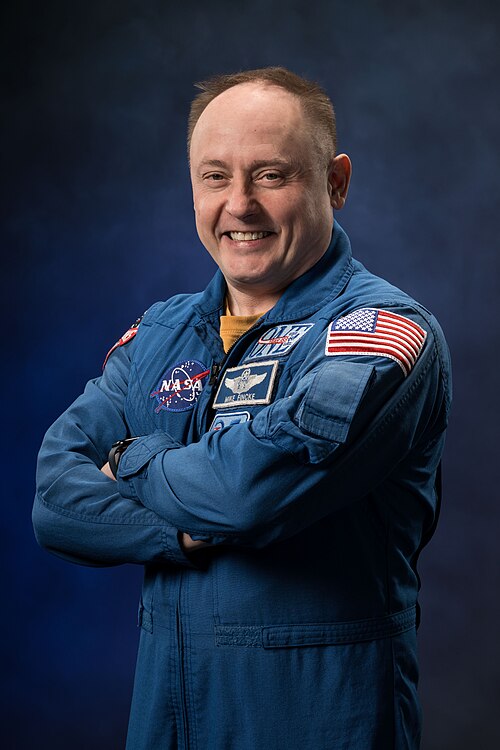
Mike is Michael Fincke (https://en.wikipedia.org/wiki/Michael_Fincke), NASA astronaut, retired USAF Colonel, and most recently commander of the International Space Station (ISS).
So every time people ask me why I gave up the chance to be an astronaut, I tell them my Mike story.
Don’t let others tell you what you should do with your career, decide for yourself what you want to do. Then do it. As they say in the Air Force, aim high!
P.S. Mike called me from Low Earth Orbit (LEO) while on the International Space Station (ISS). It said “Houston TX” on the caller ID (now labeled “Space” in my contacts), which was pretty cool. Now I can cross off “get a phone call from space” from my bucket list!
Related Posts
- * Startup Accelerator Techstars – Mentor Madness (2018-02-01)
Drinking from the firehose again. - * Plattsburgh Air Force Base ROTC Field Training 1986 (2011-11-11)
Remembering F-Flight On Veterans Day. - * AFROTC: The 54 Commands (2011-08-05)
A marching drill used for training Air Force cadets in the 1980s. - * Captain Erik Heels Honorably Discharged From The United States Air Force (2006-03-02)
I will have much to say about my Air Force years when the time is right. - * A Smattering Of Things That I’ve Learned In Life (2005-12-13)
This article explains, in a way that a resume cannot, what life experiences I have had and how these experiences have contributed to the unique perspective that I bring to everything that I do. - * United States Air Force Oath Of Office (1988-05-26)
Also known as the United States Uniformed Services Oath of Office. - * United States Air Force Oath Of Office (1988-05-26)
Also known as the United States Uniformed Services Oath of Office. - * United States Armed Forces Code Of Conduct (1984-08-31)
Also known as the Prisoner of War (POW) Code of Conduct. - * United States Armed Forces Code Of Conduct (1984-08-31)
Also known as the Prisoner of War (POW) Code of Conduct.
17 Seconds is a publication for clients and other VIPs. Powered by Mailchimp and the beat of a different keyboard player. Click here to subscribe to 17 Seconds.

Feedback like this is what keeps me writing:
“Remarkable story, thanks for sharing!” -Steve S.
“Note: my dream is to go to space, so while I am a very giving and altruistic person (or always try to be), no chance I would have given that up :)” -Scott M.
“This was so fun to read. I love knowing this about you, non-astonaut!” -Nataly K.
“Great story, thanks! I always aspired to be a pilot and I do have my commercial pilot’s license, but I also never wanted to be an astronaut even though I might be ten years older than you and remember watching the first moon landing (on my grandmother’s COLOR TV!)” -Chris B.
“Awesome story!” -Rob L.
“Awesome story Erik. Interesting how things shake out. I’d say you did just fine with your chosen career path. And, good for Mike. Quite an achievement.” -Len S.
“Way more than 17 seconds. But very cool!” -Brian L.
“I want to tell you what a cool story this is and that I enjoyed it immensely!” -Kim S.
“What a great story! Thanks for sending this.” -Betsy G.
“Thanks for the story!” -Steve H.
“Loved your story! Put a smile on my face, for sure!” -Art N.
“This is a great story my friend. Thanks for sharing it!” -Steve R.
“I LOVED THIS!!!!! Thank you so much for sharing it.” -Chris R.
“Great story! I loved reading that.” -Greg G.
“Wow!!! Best story ever! Thanks for sharing!” -Ioana U.
“An awesome story, thanks, Erik!” -Linda M.
“Thanks for sharing this remarkable and true story! Wow!” -Mary R.
“That is so awesome!” -Peter S.
“Great story. I didn’t know the part about you being offered an astronaut training slot.” -Deep D.
“Great story! I wanted to be an astronaut. Wrong country and wrong time.” -Jim B.
“Great story!” -Eric B.
“Amazing story Erik, thanks for sharing!!!” -Stelios C.
“Pretty cool story!” -Josh C.
“This was fun to read, thanks!” -Margot K.
“What a wonderful story! Worth every 17+ seconds. Thanks, for brightening my morning!” -Robin B.
“I love this story so much! Thanks for sharing.” -Carol I.
END
SEE ALSO:
https://www.giantpeople.com/17815.html
https://www.clocktowerlaw.com/6557.html
https://www.facebook.com/erikjheels/posts/pfbid033AgoCusZj6KWT5GMX2C5dJ2rNoyW75fYrFLoSfetKKXgBYGA91Vut8vu1xz4WNu4l
https://www.facebook.com/GiantPeopleLLC/posts/pfbid02xvxuL9MkjZh8VL5HtFgmvJdh1V4izuSLcCGZBbRkgEBCR64xByoqq81JBRhd2Rvpl
https://www.linkedin.com/posts/erikjheels_why-erik-heels-turned-down-the-opportunity-activity-7451019317799866368-maiZ/